



Hanfu has become increasingly popular outside China, but finding authentic styles from Chinese studios is often more complicated than expected. Most Hanfu sellers operate through Chinese platforms like Taobao and Weidian, where listings, payment systems, and shipping are primarily designed for domestic buyers.
This guide explains where to buy Hanfu from China, how buyers usually find reliable studios, and how to complete the purchase and international shipping process more smoothly.
Where to Buy Hanfu from China
Several Chinese platforms carry Hanfu, but they attract different types of sellers and serve different shopping situations. Here is a detailed introduction to several platforms.
Taobao
Taobao has the widest selection of Hanfu on any single platform. Independent studios, emerging designers, and established brands all sell there, which means styles that don’t appear anywhere else are often findable on Taobao. The range covers everything from affordable linen pieces for everyday wear to heavily embroidered formal sets from well-known studios.
Tmall
Tmall is where established Hanfu brands set up official storefronts. Prices are higher than Taobao, but you’re buying directly from the brand rather than through a third-party listing. If you already know which brand you want and prefer the assurance of an official store, Tmall is worth checking. For browsing and discovery, Taobao gives you considerably more to work with.
Weidian
Weidian is where many smaller independent Hanfu designers and studio owners set up shop, often because the platform has lower entry requirements than Taobao. Some designers operate exclusively on Weidian and have no Taobao presence at all. If you’ve seen a specific studio recommended in a community and can’t find it on Taobao, Weidian is usually the next place to check.
Xianyu
Xianyu is China’s secondhand marketplace. It’s where buyers resell Hanfu they no longer wear, including discontinued styles, limited-edition pieces, and older releases from studios that have since moved on to new designs. Prices are often lower than new listings on Taobao. Since sellers are individuals rather than businesses, quality verification before buying matters more here than it does on Taobao or Weidian.
What Kind of Hanfu Do Buyers Usually Purchase
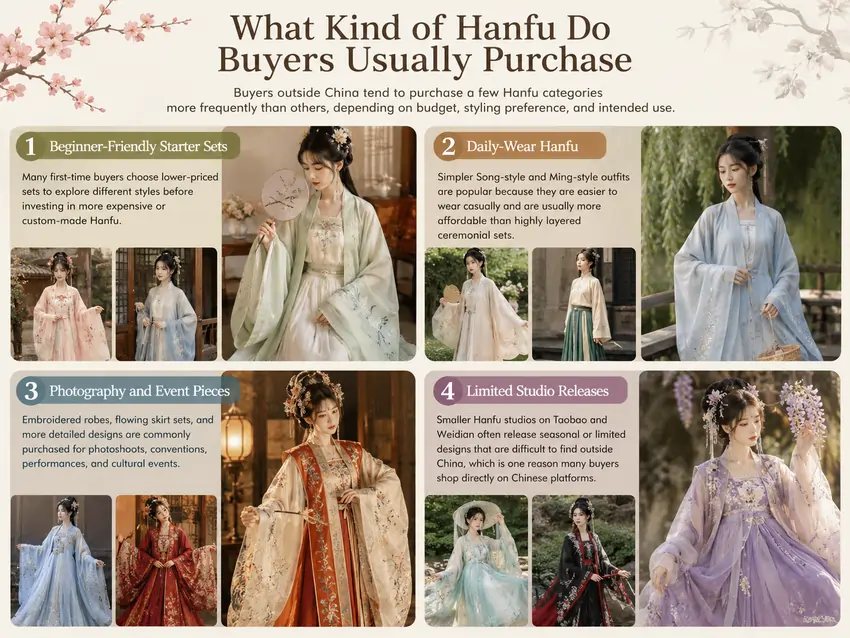
Buyers outside China tend to purchase a few Hanfu categories more frequently than others, depending on budget, styling preference, and intended use.
- Beginner-Friendly Starter Sets: Many first-time buyers choose lower-priced sets to explore different styles before investing in more expensive or custom-made Hanfu.
- Daily-Wear Hanfu: Simpler Song-style and Ming-style outfits are popular because they are easier to wear casually and are usually more affordable than highly layered ceremonial sets.
- Photography and Event Pieces: Embroidered robes, flowing skirt sets, and more detailed designs are commonly purchased for photoshoots, conventions, performances, and cultural events.
- Limited Studio Releases: Smaller Hanfu studios on Taobao and Weidian often release seasonal or limited designs that are difficult to find outside China, which is one reason many buyers shop directly on Chinese platforms.
How to Find Hanfu Sellers Worth Buying From
Finding a platform is the starting point. Narrowing down to a specific seller with consistent quality takes a bit more research. A few sources are more useful than others.
Customer photos in Taobao reviews give a more accurate picture of a garment than the listing images, which are professionally shot under controlled conditions. Reviews that include:
- Photos of the actual piece, worn or laid flat
- Comments on fabric weight and texture
- Notes on whether sizing matched the chart
These are worth reading carefully before placing an order.
Xiaohongshu is where a large share of Chinese Hanfu buyers post outfit photos and tag the stores they bought from. Searching for a style name or aesthetic, there surfaces real buyer photos with store links, which is one of the better ways to discover smaller studios before they become widely known.
Community recommendations from r/hanfu on Reddit and dedicated Hanfu Discord servers reflect firsthand buyer experience. Stores that come up repeatedly with positive feedback across multiple independent posts are generally lower risk than stores you find cold through a platform search.
Store history on Taobao is visible on the storefront page. A store that has been operating for several years with a high volume of completed orders carries less uncertainty than a newer listing, even if the newer listing has attractive product photos.
How to Complete the Purchase from Outside China
Once you’ve found the Hanfu you want, the next question is how to buy it. Chinese platforms require local payment methods, and most sellers only ship within China. Buyers outside China typically go through one of two routes.
Using a Shopping Agent
A shopping agent buys on your behalf from whichever platform the seller is on, receives the item at a warehouse in China, and ships it to you internationally. The process is straightforward:
- Find the Hanfu you want and copy the product link
- Submit the link through the agent’s platform
- Pay for the item and wait for it to arrive at the warehouse
- Review inspection photos, then choose your shipping method and pay the final fee
The inspection step is particularly useful for Hanfu. When your item arrives at the warehouse, the agent photographs it before it ships internationally. That’s the point of checking fabric quality, embroidery detail, color accuracy, and overall condition. If something doesn’t match the listing, a return to the seller is still possible at this stage.
Several agents support purchasing from Taobao, Xianyu, and Weidian. Mulebuy is one option that covers all three platforms with 0 service fees and free inspection photos included on every order.

Buying Directly
Buying directly on Taobao is possible for buyers who are in regions where the platform supports international purchases. It requires:
- Setting up an Alipay account linked to an international card
- Navigating a Chinese-language interface
- Handling seller communication and shipping independently
Direct setup offers full control for experienced users, but for most, the agent route provides a much smoother, low-friction experience.

Common Mistakes First-Time Buyers Make
Buying Hanfu from Chinese platforms is fairly straightforward once you understand how the marketplaces work, but first-time buyers often run into a few avoidable mistakes.
- Ignoring Production Times: Many Hanfu pieces are made-to-order rather than ready-to-ship, especially from smaller studios or for embroidered designs.
- Buying Based Only on Promo Photos: Listing photos are often professionally styled and edited. Customer review photos usually give a more realistic sense of fabric texture, color, and overall quality.
- Forgetting Accessories Are Sometimes Sold Separately: Hairpieces, belts, shawls, and inner layers shown in promotional images may not always be included with the main outfit.
- Misunderstanding Fabric and Layering: Some Hanfu styles use lightweight fabrics designed for visual flow rather than warmth, while others can feel heavier or more structured than expected.
- Choosing Size Based Only on Standard Labels: Chinese sizing varies significantly across studios, so relying solely on S/M/L labels without checking measurements can lead to sizing issues.
What to Know About Hanfu Sizing
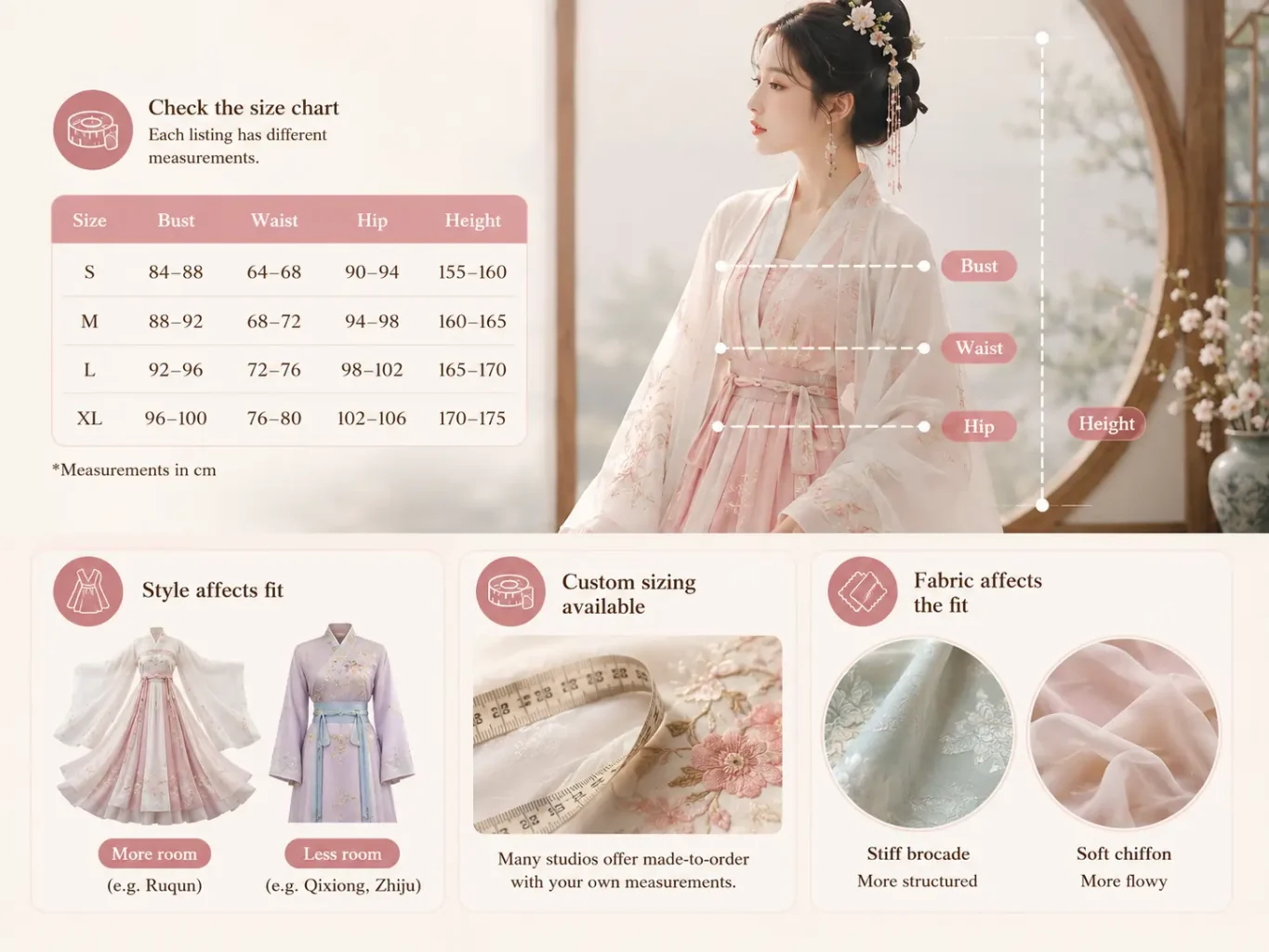
Hanfu sizing uses Chinese body measurements rather than standard Western size labels. Each listing provides its own size chart with bust, waist, hip, and height measurements specific to that garment. Checking the chart for each purchase matters, even if you’ve bought Hanfu before, since sizing varies by studio and style.
A few things worth knowing before you order:
- Style affects how closely measurements need to match. Ruqun and other layered styles have more room for variation. Fitted styles like Qixiong or Zhiju sit closer to the body and leave less margin for error
- Custom sizing is available from many studios. Made-to-order listings often allow you to submit your own measurements, which is useful if your dimensions fall between standard sizes
- Fabric affects how a piece sits. Stiff brocade drapes differently from soft chiffon at the same measurements. Reviews that mention fabric weight give you a better sense of fit before buying
How Long Does Shipping Take for Hanfu Orders from China?
Hanfu delivery involves two separate timelines that are easy to mix up.
Production time comes first. Many listings, particularly from independent studios, are made-to-order. It can take anywhere from a few days for simpler pieces to several weeks for custom or heavily embroidered designs. The listing usually states the production period. For time-sensitive purchases, confirm the timeline with the seller before ordering.
International shipping time depends on the route. If you’re buying through an agent, you can select the shipping line after the item arrives at the warehouse, so there’s flexibility at this stage.
- Economy lines typically take two to four weeks and work well for non-urgent orders
- Express options are faster but cost more, and make more sense for high-value or time-sensitive purchases
Combined, the realistic window from order to delivery is usually three to six weeks for standard pieces, longer for custom or complex designs.
Conclusion
Buying Hanfu from China is mainly about choosing the right platform and using the right purchasing method. Platforms like Taobao offer the best selection for individual buyers, but the process can be challenging without the right tools. By using a shopping agent when needed, you can simplify payment, communicate with sellers, and arrange reliable international shipping, all in one streamlined process.
FAQs
For most buyers outside China, yes. Chinese platforms require local payment methods, and most sellers ship domestically only. An agent handles both, and the warehouse inspection step adds a layer of quality verification before anything ships internationally.
Each listing uses Chinese body measurements rather than Western size labels, and each seller provides their own chart. Checking the size chart against your actual measurements for every purchase is the most reliable way to get the fit right. Many studios also offer custom sizing for made-to-order pieces.
The practical window for returns is while the item is still at the agent’s warehouse in China. Reviewing inspection photos carefully before authorizing international shipment is the point where flagging a problem is still manageable. Once the parcel ships internationally, arranging a return becomes significantly harder.
Xiaohongshu is one of the most effective ways to discover smaller studios. Searching for a style or aesthetic, they surface real buyer photos with store tags. Reddit’s r/hanfu and Hanfu-focused Discord communities are also useful for store recommendations and quality comparisons from buyers with direct experience.